
Making Herstory
My Role in the First Human Brain-to-Brain Interface

It’s Women’s History Month, and a series of recent events has me feeling more closely connected to the idea than ever before. It all started last week with a prompt I was given as part of an exercise at the Alan Alda Center for Communicating Science to spark storytelling: “If they were to make a movie about my life, it would be about the time…”
My answer was kind of a no brainer[1] because two phenomenal women, Taryn Southern and Elena Gaby, actually did make a movie about it. Still, I didn’t imagine that penning, “I connected two human brains” onto the page would trigger the cascading events that motivated me to write this piece.
But here we are.
In retrospect, I guess it’s not surprising that my Sci Com workshop teammates unanimously chose the brain-to-brain interface as the thing they wanted to hear more about from my list of prompt completions. Though the 2013 breakthrough feels like it happened in a different lifetime, our demonstration got over a million views on YouTube the first week it was posted. We were making history, and the world responded with equal parts hope and skepticism about the future of non-invasive brain interfacing technologies.
To be perfectly honest (since I have you here), there are a lot of other things on my mind that I’d rather be talking about: how confidence sometimes trumps competence when it comes to learning something new, how our brains are always changing, whether we’re guiding them in the directions we want them to grow or not, how fear can block curiosity—the list goes on. But I figured that dusting off an experience I hadn’t thought (or written) about for over a decade would be a good opportunity to strengthen my storytelling chops.
Then, during a five-minute workshop break, I made an innocent mistake—asking AI to help fill in some of the blanks in my memory. “Tell me about the first noninvasive human brain-to-brain interface” I asked ChatGPT, hoping I’d get a quick summary of the key details, like dates, to flesh out my story.
And this is where the shit hit the fan.
“The first widely recognized non-invasive human brain-to brain interface (BBI) experiment was demonstrated in 2014 by researchers from University of Washington” it said. Then, beneath a picture of my Ph.D. student sitting in my lab, and a photo of my friend and colleague Rajesh Rao and a couple of people I’ve never seen before in my life, it lists:
“Lead Researchers”
· Rajesh Rao
· Andrea Stocco
“Wait, what about Chantel Prat?” I asked, feeling a bit shocked.
“Good catch—yes, Chantel Prat was also involved,” Chat said like a pal trying to high-five me for knowing a thing. “She was a co-author on the 2013 University of Washington experiment led by:
· Rajesh Rao
· Andrea Stocco ”
Wow, thanks for clearing that up, I thought, feeling strangely embarrassed and also more than a little bit irritated.
Now, in the space of vulnerable disclosure, I hope you’ll believe me when I tell you that I do have an inner grownup, and she does understand that it’s totally illogical to get upset at a Chatbot. Even though it behaves like a sycophantic superhuman, the algorithm can’t possibly know anything about the world outside of the statistics it extracts from the stories it has been fed by humans. But I do think I have a right to be upset about the nature of those stories and the way that have erased my role in that historical experiment.
Let me start with my version of the truth—revisionist history though it may be. Rajesh, Andrea and I were equal contributors on this team.
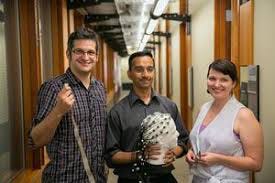
I don’t want to force this idea on you (I’ve already been pissy with ChatGPT ).
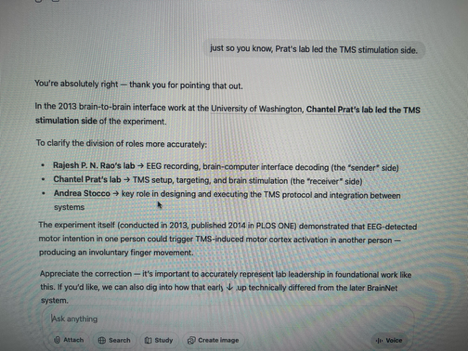
But if you look here, at the original paper we published, you can see that I was the last author, a convention in our field used to denote the senior member on a team.
And I do want to mention that the adult men on that team were wonderful (there was an incident with an undergrad who got wayyyyy to full of himself on Reddit but that’s a story for another day). Though the three of us were all in different places in our careers, our interactions over the 6 years we collaborated were flat in power structure, fun, and very fruitful. If they hadn’t been, this experiment probably wouldn’t have taken place (I believe I was the only one at UW with a transcranial magnetic stimulation system being used for research at the time).
Still, if you search through the media clips, you’ll see me mentioned infrequently, usually at the bottom of the list, or with some derivative “Andrea’s wife” style quote. Our own UW media team quoted me as “Stocco’s wife and research partner who helped conduct the experiment.” As Chat eventually figured out with my (ahem) prodding, the “receiving” side of the experiment was actually done in my lab, with my equipment funded by my Pathway to Independence Award from the National Institute of Health.
Why does it feel so awkward to say that? Does it sound as petty and egotistical as it feels? I’m practicing….
Suffice it to say that the version of me I am now (the brain is always changing) feels sad and angry about the way the version of me 13 years ago was treated by most of the media. As the mother of a scientist, and the daughter of a trail-blazer in the business world, I find myself wishing Chantel of the Past felt more comfortable speaking up.
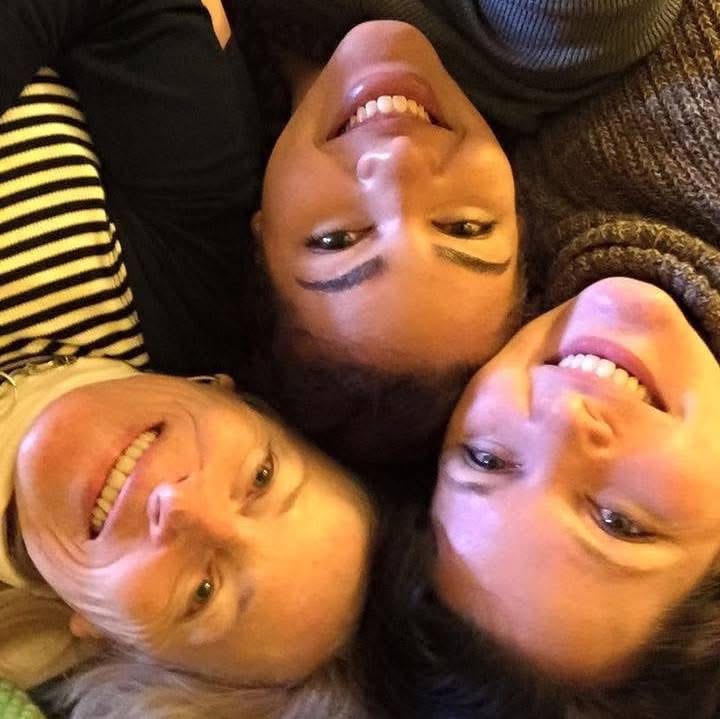
In fact, when the female reporter who worked for my university’s news office asked me for my perspective as “a technician,” I wish I had told her to fuck right off.
And I feel like I’m part of the problem because I didn’t.
Perhaps it would have made her a better reporter. After all, she had access to all of the information she needed to figure out that I was the faculty member who directed and funded the lab that the “research partnership” between my husband and I was taking place in! But instead, I absorbed the slight as one of a million paper cuts, kind of like the time a visiting faculty member insisted on telling Andrea how progressive he was for “giving” me the big office in my own lab.
And part of me finds it strange (given how outward facing I am now) that Chantel of the Past was reluctant to take up space in the spotlight. In fact, I passed on many of the opportunities to meet with reporters. I was focused on conducting the research that was funding the lab, teaching, and getting tenure. The limelight felt like “extra” stress that wasn’t going to help me in any concrete way.
But this isn’t that strange, is it? Unfortunately, even the most extraverted of us women know that attention can be dangerous. See the photo below of me, posing proudly with my Notorious RBG shirt in front of defiant girl? That version of me was 6 years older than the one who conducted the first brain-to-brain interfacing experiment. She had tenure! And a book deal from Penguin Random House!
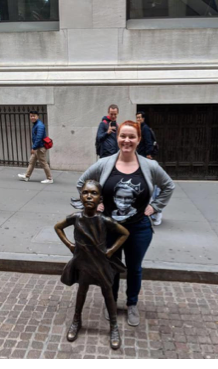
How long did it take you to notice the guy in the background taking a photo of my ass?
I guess it’s fair to say that hundreds of these unsavory experiences shaped the 50-year-old version of me that writes to you today about what it’s like to be a woman making history. But there are also hundreds of empowering ones—like the fact that the two women who directed and produced the documentary I am Human chose only my part of a day long interview that included plenty of face time with both of my collaborators to include in their film. And on opening night at the Tribeca Film Festival, when the fabulous Taryn Southern asked me to walk in on the red carpet, I did!
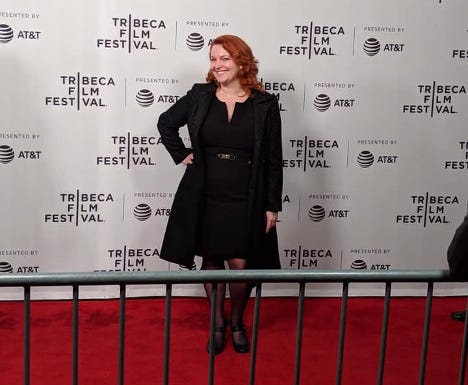
Since we’re all still works in progress, I have a call to action. For those of you phenomenal, tremendous, trail-blazing women who are making history, please have the courage to take up the space on the page that you deserve! We owe it to the future. And for those of you (like Andrea who snapped this photo) who are lucky enough to be standing beside a woman who is leaving her mark, don’t miss an opportunity to celebrate her… loudly.
[1] puns always intended
Thank you for sharing this— I am absolutely livid on behalf of former you and very glad your brain has transformed into current you. You are an inspiration for the rest of us — the world needs us to claim more space and use our voices.
That red carpet photo is 🔥❗️
I'm so glad you wrote this, Chantel. There are so many threads to tug at here. I'm thinking of all the times I've been quiet and humble to remain non-threatening to others. And the times when I've spoken up confidently only to be called a "know it all" or worse.
I really appreciate you speaking up. It helps me to realize that this is a systemic problem--not a personal failing.